Why AI Tool Roundups Became Necessary
Between 2022 and 2024, the number of publicly available AI writing and text tools grew from a handful of recognizable names to several hundred competing products. That pace created real problems for anyone trying to choose sensibly.
Many tools claim similar capabilities. Summarizers, paraphrasers, grammar checkers, and detection platforms now overlap in ways that make individual product pages nearly useless for comparison. A vendor's own description will rarely tell you where the tool falls short, what data it retains, or whether a free tier actually covers your use case.
For educators and institutional staff, the stakes are higher than convenience. Questions around student data privacy, FERPA compliance, and acceptable use policies require more than a feature list. Cost structures shift frequently, access limits vary by plan, and some tools quietly change their terms after launch.
Structured roundups cut through that noise. Placing tools side by side against consistent criteria, whether cost, privacy policy, or task fit, gives users a reliable basis for comparison that promotional content simply cannot offer.
How Curated Lists Group Text Tools by Category and Use Case
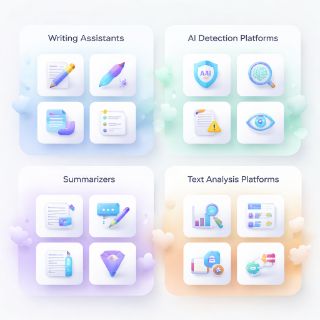
Strong roundups rarely present tools as a flat alphabetical list. Grouping by function is what makes a comparison actually useful.
Most lists organize around four core categories. Writing assistants handle drafting and revision, tools like Grammarly or Jasper being common examples. AI detection platforms, such as Turnitin's AI detection or GPTZero, flag machine-generated text. Summarizers condense long documents into shorter forms. Text-analysis platforms go deeper, examining tone, readability, or argument structure across larger content sets.
Categories do overlap. A tool like QuillBot functions as both a paraphraser and a summarizer. Some detection tools also offer readability scoring. Readers benefit when roundups acknowledge this rather than forcing clean separations.
Sorting by use case adds another layer of clarity. A student looking for reading support needs different guidance than an administrator evaluating institutional analytics. Roundups that tag tools by task, whether drafting, plagiarism review, or feedback, let readers compare options in context rather than guessing which category applies to their situation.
What Users Can Compare More Easily in a Good Roundup

Placing competing tools side by side immediately removes the need to open a dozen separate pricing pages. A well-built roundup surfaces the details that actually shape decisions: core features, supported languages, accuracy signals, and how each tool handles user data.
Pricing tiers matter more than most product pages admit. Some tools offer generous free plans, others cap outputs at 2,000 words per month or require an annual commitment to access API integrations. A roundup that maps these conditions clearly saves hours of trial-and-error.
Data handling is often buried in terms of service. Roundups that flag whether a tool trains on submitted content, or whether enterprise tiers offer data isolation, translate legal fine print into plain guidance.
Model transparency is another point of comparison worth surfacing. Knowing whether a summarizer runs on GPT-4, a proprietary model, or an open-source alternative affects trust, output consistency, and institutional compliance decisions.
Better Roundups Lead to Better Tool Decisions
Curated lists have become one of the more practical responses to a market that expanded faster than most users could track. When dozens of writing assistants, detection tools, summarizers, and text-analysis platforms emerged within a short window, choosing between them without guidance meant hours of trial-and-error or relying on vendor claims alone. A well-structured roundup cuts through that by grouping similar products, naming real differences in function and pricing, and flagging data-handling considerations that matter to institutional users. The most useful ones don't try to list everything – they narrow the field based on specific use cases, whether that's academic writing support, content detection, or bulk text processing. There's no denying that a longer list can feel more thorough, but length rarely equals usefulness. The roundup that helps a user choose the right tool for their actual context, not just the most popular one, is the one worth returning to.